
Assets and depreciation
A laptop is not an ordinary cost
Above a certain amount you may not deduct a camera, toolbox or company car in one go: you depreciate it over several years. In Katsjing you record the asset once — purchase date, amount, depreciation period and residual value — and after that the depreciation runs through your figures by itself.
What you can do with it
- Every asset in one overview, with purchase value and current book value.
- Depreciation per period calculated automatically and carried into your result.
- See which assets are nearly written off, so an investment is never a surprise.
- What you invested this year comes back under the investment allowance.
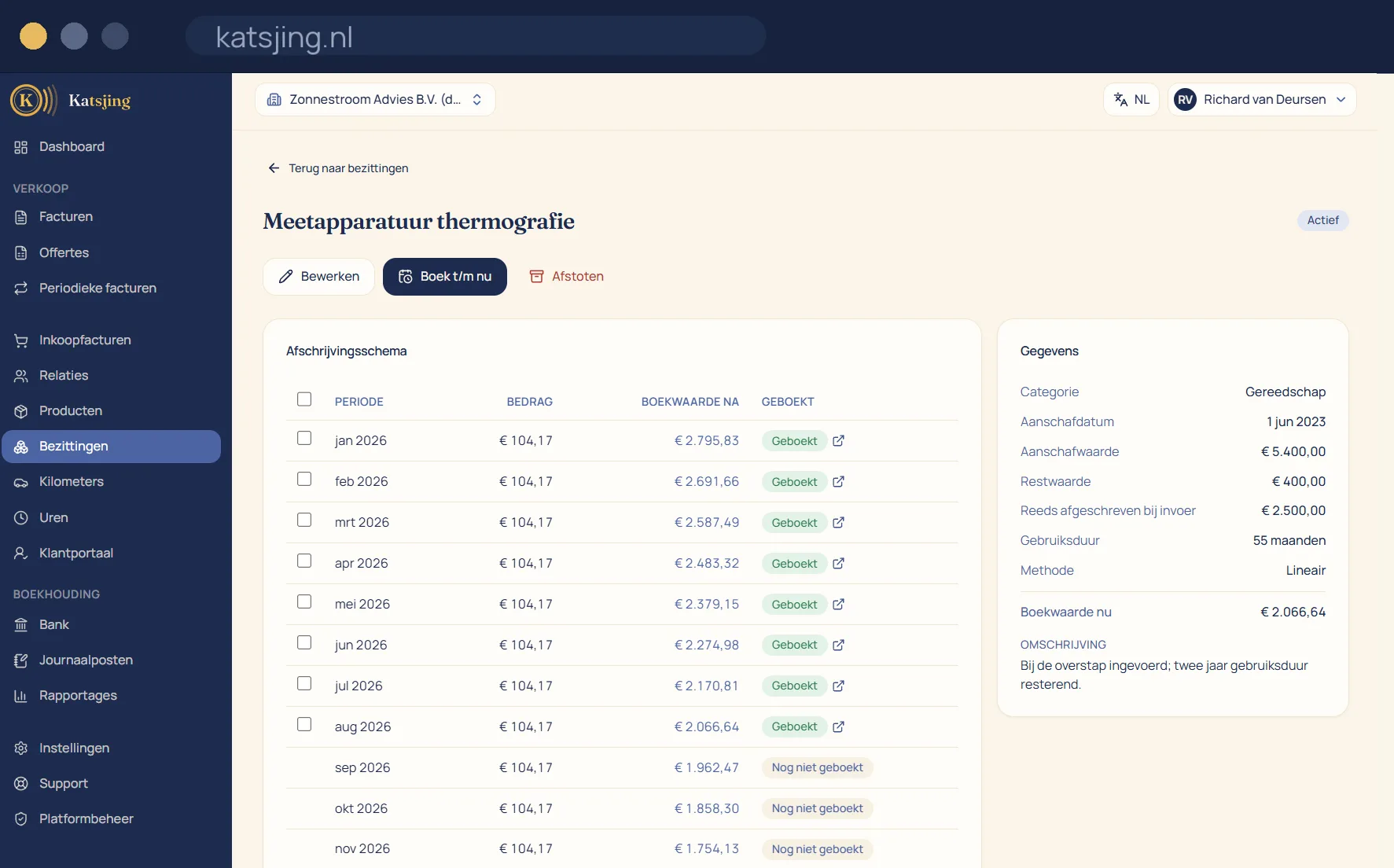
Record it once, then it runs by itself
You record an asset with the purchase date, the amount, the useful life and, if any, a residual value. Katsjing books the purchase on the balance sheet and then depreciates it on a straight-line basis every month, quarter or year, as you choose. That depreciation happens automatically, even if you don't log in for a while: Katsjing catches up on overdue periods by itself.
From purchase invoice to asset
Already booked the laptop or camera as a purchase invoice? Then you turn it into an asset from that invoice. The amount then moves from your costs to your balance sheet, so your profit in the year of purchase doesn't come out too low. If you bring along an asset that has already been partly depreciated, you enter how much of it is left, and Katsjing carries on from there.
Selling or disposing
If you sell an asset or dispose of it, Katsjing books the difference between the sale price and the book value as a gain or loss, and stops the depreciation. In the advice overview you see what you invested this year according to your assets, as a starting point for the investment allowance.
Frequently asked questions
- From what amount do I have to depreciate something?
- That's for the tax authority to decide, not Katsjing. Katsjing doesn't track a threshold for you; you decide yourself whether to record a purchase as an asset.
- Which depreciation method does Katsjing use?
- Straight-line: every year an equal share of the purchase price minus the residual value. You choose whether that is booked per month, per quarter or per year.
- Does Katsjing calculate my investment allowance?
- No. You see what you invested according to your assets, but whether you get an investment allowance and how much is something you settle in your tax return, with your adviser if you like.
Included in every paid plan
There is no basic version with half a feature list: every feature above is included in both paid plans. What differs is how much of it you use: the number of sales invoices per month, users, trade names and automatically read receipts. ZZP is for sole traders; Onderneming has room everywhere and lets you switch off the Katsjing mention on your invoices. You can also start for free, with a monthly limit on the number of invoices.
See the plans